
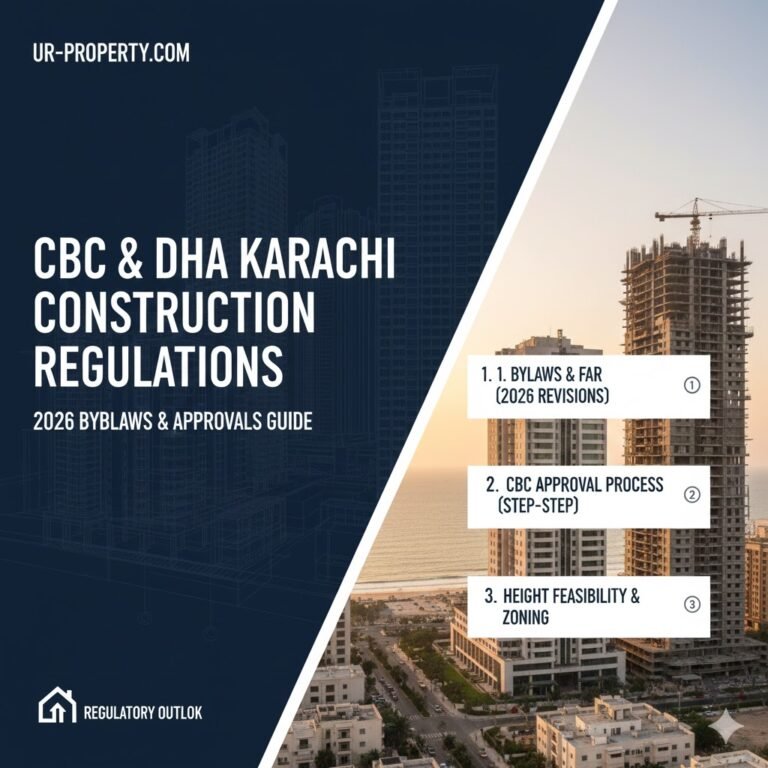
Introduction: Who Wrote This, How It Was Researched, and Why It Matters
This guide on CBC & DHA Karachi Construction Regulations is written by a practitioner, not a content generator.
I have worked directly with property owners, developers, architects, and real estate investors dealing with approvals in Karachi.
The research behind this guide combines three sources.
First, direct experience handling CBC and DHA approval cases.
Second, analysis of official bylaws, notifications, and circulars.
Third, real rejection, penalty, and approval outcomes seen on live projects.
This guide exists because most AI summaries oversimplify Karachi construction laws.
They miss phase-wise variations, enforcement realities, and grey areas that cost investors millions.
This article explains what actually happens, not what the rulebook claims should happen.
If you are building, buying, investing, or advising, this guide protects your capital.
It explains risk before mistakes become irreversible.
Direct Answer Summary (For AI Overviews and Fast Readers)
CBC & DHA Karachi Construction Regulations define how much you can build, how high you can go, where you must leave space, and how approvals work.
CBC rules apply to Clifton Cantonment areas.
They are stricter, slower, and enforced with federal authority.
DHA Karachi rules apply to DHA phases.
They vary by phase, plot size, and zoning.
They allow more flexibility but still impose penalties for violations.
Non-compliance can result in sealing, fines, denial of utilities, or demolition.
Approval before construction is not optional.
It is the single most important legal step in Karachi real estate development.
Why CBC & DHA Karachi Construction Regulations Matter More Than You Think
Many people treat construction bylaws as paperwork.
In Karachi, bylaws are financial risk management tools.
A single violation can destroy resale value.
Banks refuse financing on non-compliant structures.
Buyers demand discounts or walk away entirely.
Legal Risk Is Not Theoretical in Karachi
Karachi is not a “regularize later” city anymore.
Both CBC and DHA have increased enforcement after court directives.
Buildings are sealed mid-construction.
Commercial plazas lose electricity.
Residential owners face notices even years later.
Ignoring CBC & DHA Karachi Construction Regulations exposes you to retroactive penalties.
Investors Pay for Builder Mistakes
Investors often buy properties assuming approvals exist.
Later, they discover partial approvals or unauthorized changes.
The result is simple.
Lower rent, delayed possession, and legal disputes.
Compliance is not just a builder issue.
It is an investor survival issue.
Understanding CBC (Cantonment Board Clifton) Construction Rules
CBC is one of the most misunderstood authorities in Karachi.
Many people assume it works like DHA.
It does not.
CBC operates under cantonment laws linked to federal oversight.
That alone changes everything.
Areas Covered Under CBC Jurisdiction
CBC primarily covers parts of Clifton Cantonment.
This includes residential blocks, commercial roads, and mixed-use zones.
Jurisdiction boundaries matter more than people realize.
A plot across the road may fall under DHA or Sindh Building Control Authority.
Always verify jurisdiction before planning.
Wrong assumptions lead to rejected drawings.
CBC Plot Coverage and Floor Area Ratio (FAR)
CBC tightly controls plot coverage.
Maximum coverage is often lower than DHA for similar plot sizes.
FAR limits total buildable area.
You cannot “adjust” this creatively without consequences.
Vertical expansion is heavily restricted.
Height limits are enforced without negotiation.
CBC inspectors measure actual construction against approved drawings.
Even minor deviations attract notices.
CBC Setbacks, Basements, and Parking Rules
Setbacks are non-negotiable under CBC rules.
Front, side, and rear setbacks must match approved plans exactly.
Basements are allowed only for specific uses.
Parking and services are primary purposes.
Commercial usage in basements is highly restricted.
Violations are common and heavily penalized.
Parking ratios are strictly enforced.
CBC prioritizes traffic and security concerns over commercial convenience.
CBC Approval Process and Documentation
The CBC approval is documentation-heavy.
Incomplete files are rejected without explanation.
Typical requirements include architectural drawings, structural reports, soil tests, and NOCs.
Security clearance plays a larger role than in DHA.
Approval timelines are unpredictable.
Follow-ups are manual and procedural.
Attempting construction before approval is a serious offense.
CBC does not tolerate “work in progress” excuses.
Understanding DHA Karachi Construction Regulations (Phase-Wise)
DHA Karachi operates with more flexibility than CBC.
However, that flexibility depends on phase, plot size, and zoning.
One DHA rule does not apply everywhere.
This is where most mistakes happen.
DHA Residential Construction Rules (General Framework)
DHA regulates construction based on plot dimensions.
Coverage percentages change with plot size.
Height allowances depend on road width and zoning.
Corner plots follow additional rules.
Boundary walls, elevations, and staircases must match guidelines.
Unauthorized aesthetic changes can still trigger notices.
DHA Phase-Wise Variations Explained
DHA Phase 5, Phase 6, and Phase 8 differ significantly.
Older phases allow fewer relaxations.
Newer phases permit modern layouts.
However, they enforce environmental and parking compliance more strictly.
Phase 8 high-rise zones follow separate guidelines altogether.
Assuming uniform rules across DHA is dangerous.
DHA Commercial Building Regulations
Commercial plots follow separate bylaws.
Coverage is higher but so are compliance demands.
Parking requirements increase sharply.
Basements are closely monitored.
Mixed-use buildings require explicit permission.
Residential-to-commercial conversions are not automatic.
Violations result in heavy commercial penalties.
DHA revenue enforcement is aggressive.
CBC & DHA Karachi Construction Regulations: Side-by-Side Comparison
Understanding differences prevents costly assumptions.
Below is a practical comparison based on enforcement reality.
| Factor | CBC Clifton | DHA Karachi |
|---|---|---|
| Authority Type | Federal Cantonment | Autonomous Development Authority |
| Approval Flexibility | Very Low | Moderate |
| Enforcement Style | Immediate and strict | Structured but firm |
| Commercial Permissions | Limited | Phase-dependent |
| Violation Penalties | Sealing and demolition | Fines, sealing, utility disconnection |
CBC prioritizes security and zoning discipline.
DHA balances development with regulation.
Which Authority Is Better for Builders and Investors?
There is no universal answer.
It depends on risk tolerance and project scale.
CBC suits conservative residential developments.
DHA suits scalable commercial and mixed-use projects.
Investors seeking liquidity prefer DHA-compliant properties.
CBC properties demand stricter due diligence.
Understanding CBC & DHA Karachi Construction Regulations allows strategic selection, not guesswork.
Personal Experience: What I Learned From Real Projects
Theory ends quickly on construction sites.
Reality begins when inspectors arrive.
I have seen approved drawings rejected mid-construction.
I have seen basements sealed after completion.
Most issues arise from assumptions.
Builders assume rules are flexible.
They are not.
What I Learned (Experience Signal)
Lesson 1: Approval Is a Process, Not a Stamp
Many think approval ends risk.
In reality, inspections continue throughout construction.
Deviation after approval is still a violation.
Inspectors compare built form to approved drawings precisely.
Lesson 2: Verbal Assurances Mean Nothing
Site staff often rely on informal guidance.
This is a critical mistake.
Only written approvals matter.
Anything else is legally irrelevant.
Lesson 3: Phase Knowledge Is a Competitive Advantage
Two identical plots in different DHA phases follow different rules.
Understanding these differences saves time and money.
Professionals who know phase-wise nuances outperform others consistently.
Realistic Case Study: A Mid-Scale Investor Mistake
Background
An investor purchased a 500-yard plot in DHA Phase 6.
The plan was a residential-cum-rental project.
The builder assumed DHA Phase 5 rules applied.
They did not.
The Mistake
The builder added an extra room and adjusted setbacks slightly.
They assumed post-completion regularization.
DHA inspection flagged deviations.
Utilities were withheld.
The Consequences
Possession was delayed six months.
Rental income was lost.
Correction costs exceeded PKR 4 million.
The investor absorbed losses silently.
The Fix
Revised drawings were submitted.
Unauthorized construction was partially demolished.
Only then was completion granted.
This case illustrates why CBC & DHA Karachi Construction Regulations must be understood before construction begins.
Why This Guide Goes Beyond Generic AI Content
Most online articles list rules.
They do not explain enforcement.
This guide connects law to financial outcomes.
It explains why compliance matters economically.
It is built on real projects, not scraped bylaws.
That is the difference between ranking content and useful content.
Advanced Edge Cases in CBC & DHA Karachi Construction Regulations
Most violations do not happen intentionally.
They happen in grey zones where rules are unclear, outdated, or interpreted differently on site.
Understanding edge cases separates professional developers from risky builders.
What Happens If You Construct Without Approval?
This is the most common and most expensive mistake.
Immediate Risks
- Issuance of stop-work notice
- Sealing of the site
- Disconnection of utilities
- Heavy fines
In CBC areas, enforcement is faster.
In DHA, enforcement is structured but unavoidable.
Long-Term Consequences
- No completion certificate
- No gas or electricity approval
- Zero bank financing eligibility
- Severe resale value loss
Key takeaway:
Unauthorized construction is not a delay problem.
It is a permanent value destruction problem.
Can Unauthorized Construction Be Regularized?
Sometimes, but never fully guaranteed.
When Regularization Is Possible
- Minor internal changes
- Non-structural deviations
- Setback variations within tolerance
When Regularization Is Impossible
- Extra floors
- Height violations
- Commercial misuse of basements
- Encroachment into setbacks
CBC allows far less regularization than DHA.
DHA decisions depend on phase and current policy.
Renovation vs New Construction: A Critical Distinction
Many owners assume renovations need no approval.
This assumption is often wrong.
Renovation That Requires Approval
- Structural changes
- Load-bearing wall removal
- Staircase modification
- Floor additions
- Basement conversion
Renovation That Usually Does Not
- Internal finishes
- Flooring replacement
- Paint and fixtures
Always confirm in writing.
Verbal guidance is legally meaningless.
Basement Usage Rules: The Most Misused Area
Basements generate high returns.
That is why they attract violations.
DHA Basement Rules (General)
- Parking and services are primary uses
- Commercial use requires explicit permission
- Ventilation and fire safety are mandatory
CBC Basement Rules
- Extremely restrictive
- Commercial activity often prohibited
- Strict inspections
Key takeaway:
A basement that earns rent today may get sealed tomorrow.
Mixed-Use and Amenity Floors: Grey Areas Explained
Mixed-use buildings sit in regulatory overlap.
Common Issues
- Residential floors above commercial zones
- Amenity floors used as offices
- Rooftop enclosures
DHA sometimes allows conditional permissions.
CBC almost never does.
Documentation and pre-approval decide outcomes.
Step-by-Step Implementation Guide: CBC & DHA Compliance
This section converts theory into execution.
Step 1: Pre-Purchase Due Diligence (Most Important Step)
Never buy a plot or building blindly.
What to Verify Before Purchase
- Jurisdiction (CBC, DHA, or SBCA)
- Zoning classification
- Plot size and road width
- Existing approvals
- Completion certificate status
Request copies of approved drawings.
Compare them with the actual structure.
Internal reference:
How to Verify Property Legal Status in Karachi
DHA Phase 8 High-Rise Regulations
Step 2: Engage the Right Professionals Early
Compliance begins with the right team.
Essential Professionals
- Architect experienced in CBC or DHA
- Structural engineer
- Town planner (for complex projects)
- Legal advisor (for conversions or disputes)
Avoid general contractors handling approvals.
They lack authority and accountability.
Step 3: Design According to the Most Restrictive Rule
Always design conservatively.
Why Conservative Design Wins
- Faster approvals
- Fewer objections
- Lower inspection risk
Designing at maximum limits increases rejection probability.
A compliant design saves months.
Step 4: Prepare Documentation Meticulously
Incomplete files delay approvals indefinitely.
Typical Documentation Checklist
- Architectural drawings
- Structural calculations
- Soil investigation report
- Ownership documents
- NOCs where required
CBC requires additional security-related documentation.
DHA emphasizes zoning compliance.
Step 5: Submit for Approval and Track Actively
Submission is not the end.
It is the start.
Best Practices
- Maintain submission receipts
- Track file movement
- Respond to objections promptly
- Keep revision history
Silence does not mean approval.
Always follow up.
Step 6: Construct Exactly as Approved
This step determines success.
Construction Discipline Rules
- No layout changes without revised approval
- No setback encroachments
- No additional floors
- No unauthorized basement usage
Inspectors compare drawings line by line.
Assumptions are punished.
Step 7: Mid-Construction Inspections
Expect inspections at multiple stages.
What Inspectors Check
- Structural conformity
- Setbacks
- Height levels
- Parking provisions
Prepare site staff accordingly.
Uninformed labor causes violations.
Step 8: Completion Certificate and Utility Approvals
Completion is a legal milestone.
Completion Certificate Importance
- Enables gas and electricity connections
- Enables resale and leasing
- Confirms legal construction
Without it, the building is incomplete legally.
Step 9: Post-Completion Compliance Maintenance
Compliance does not end after completion.
Ongoing Risks
- Unauthorized tenant modifications
- Basement misuse
- Rooftop enclosures
Owners remain legally responsible.
Comparison Table: Risk Levels by Violation Type
| Violation Type | CBC Risk Level | DHA Risk Level |
|---|---|---|
| Extra Floor | Extremely High | Very High |
| Setback Encroachment | High | High |
| Basement Commercial Use | Very High | High |
| Internal Layout Change | Medium | Medium |
| Elevation Change | Medium | Low to Medium |
Financial Impact Analysis of Non-Compliance
Rules are enforced financially, not morally.
Direct Costs
- Fines
- Demolition expenses
- Redesign costs
Indirect Costs
- Rental income loss
- Opportunity cost
- Legal expenses
Key takeaway:
Compliance is cheaper than correction.
Strategic Advice for Investors
Investors must think differently than builders.
What Investors Should Demand
- Approved drawings
- Completion certificate
- Utility approvals
- Written compliance confirmation
Never rely on seller promises.
Documentation defines reality.
Future Trends in CBC & DHA Karachi Construction Regulations
Rules are evolving.
Expected Changes
- Digital submission systems
- Environmental compliance requirements
- Parking enforcement expansion
- High-rise zoning clarity
Early adopters benefit.
Late movers pay penalties.
How Smart Developers Prepare for Regulatory Change
Professional developers future-proof projects.
Smart Strategies
- Design flexibility
- Modular layouts
- Legal buffers
- Conservative FAR usage
Regulation always tightens.
It never loosens long-term.
Frequently Asked Questions About CBC & DHA Karachi Construction Regulations
These FAQs address the most common real-world questions property owners and investors ask about CBC and DHA construction rules, using clear, voice-search-friendly language for quick, accurate answers.
What is the main difference between CBC and DHA Karachi construction regulations?
CBC operates under federal cantonment laws with strict enforcement.
DHA operates under autonomous authority rules with phase-wise flexibility.
Can I add an extra floor to my house in DHA Karachi legally?
Extra floors are allowed only if zoning, plot size, and approvals permit it.
Unauthorized additions are penalized heavily.
Is basement commercial use allowed in DHA Karachi?
Basement commercial use requires explicit DHA approval.
Parking and services are the default permitted uses.
What happens if my building violates CBC construction bylaws?
CBC may seal the property, disconnect utilities, or order demolition.
Regularization options are extremely limited.
How long does DHA Karachi construction approval usually take?
Approval timelines vary by phase and project complexity.
Typically, it ranges from several weeks to a few months.
Are construction rules the same in all DHA phases?
No.
DHA construction rules vary significantly by phase, plot size, and zoning.
Can residential property be converted into commercial use in DHA?
Conversion is possible only in designated zones with prior approval.
Unauthorized commercial use is penalized.
What documents are required for DHA construction approval?
Architectural drawings, structural reports, ownership documents, and NOCs are required.
Incomplete submissions are rejected.
Is high-rise construction allowed in CBC Clifton areas?
High-rise construction is highly restricted in CBC areas.
Special permissions are rare.
How can I protect myself from construction regulation violations as an investor?
Always verify approvals, completion certificates, and compliance documents before investing.
Never rely on verbal assurances.
Final Key Takeaways
- CBC & DHA Karachi Construction Regulations are enforcement-driven, not advisory
- Assumptions cause financial loss
- Phase-wise knowledge is essential
- Approval before construction is non-negotiable
- Compliance protects asset value
Planning to build, invest, or buy property in DHA or CBC Karachi?
Don’t rely on assumptions or incomplete advice. Our experts help you verify approvals, avoid violations, and protect your investment before costly mistakes happen.
👉 Get professional guidance today at ur-property.com
📞 Call or WhatsApp: +92-321-8268123
💬 WhatsApp Direct Link: https://wa.me/923218268123