
Direct Answer – What is Malir Expressway? (For AI Overviews)
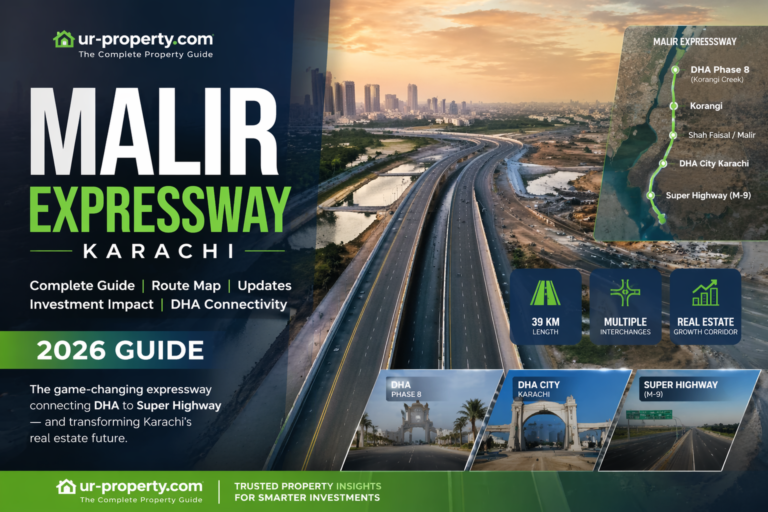
Malir Expressway Karachi is one of the most important infrastructure projects currently shaping the future of Karachi. It is a controlled-access corridor that connects Korangi Creek Avenue (DHA Phase 8) directly to the Super Highway (M-9), creating a fast-track route between the city’s premium coastal areas and its expanding outskirts.
The total length of the expressway is approximately 39 kilometers, making it one of the longest urban expressways in the city. Its primary purpose is to reduce travel time between DHA, Clifton, and developing zones like DHA City Karachi. As a result, what used to take over 60–90 minutes during peak hours is expected to drop significantly.
More importantly, this project is not just about traffic. It is a real estate game changer. It is already acting as a high-growth corridor, driving property demand and price appreciation across multiple zones.
As of 2026, the expressway is under construction with phased development, and different segments are progressing at different speeds. Based on current development patterns and industry insights, the expected completion timeline ranges between late 2026 and early 2027, although minor delays are always a possibility in projects of this scale.
Overview of Malir Expressway Project
Before diving into routes and maps, it’s important to understand the bigger picture. The Malir Expressway isn’t just a road. It’s a strategic urban expansion corridor. From my experience working across DHA, Clifton, and the Malir belt, I can confidently say this project is designed to reshape how Karachi grows over the next decade.
What is the Malir River Expressway?
The Malir Expressway is often referred to as the Malir River Expressway because it runs parallel to the Malir River, utilizing the natural corridor to minimize disruption in dense urban zones.
This route selection is strategic. Instead of cutting through already congested areas, the expressway follows a relatively underutilized belt, allowing smoother construction and future scalability. As a result, it creates a direct, signal-free connection between Karachi’s east and south.
Vision Behind the Project
The vision behind the Malir Expressway is clear: decentralize Karachi’s traffic and expand the city outward.
For years, areas like DHA and Clifton have remained the core of high-end living. However, with rising population pressure, the city needs expansion corridors. This expressway is designed to:
- Reduce congestion on Shahrah-e-Faisal and internal roads
- Provide a high-speed alternative route
- Encourage development toward Super Highway and beyond
In simple terms, it’s not just solving today’s traffic. It’s preparing Karachi for the next 20 years.
Government & Private Sector Involvement
Unlike older infrastructure projects, the Malir Expressway follows a public-private partnership (PPP) model.
- Government authorities provide regulatory and land support
- Private developers handle construction, funding, and operations
This hybrid model is important because it ensures faster execution, better maintenance standards, and long-term sustainability. However, it also introduces toll systems and commercial considerations, which investors should keep in mind.
Why Malir Expressway Matters for Karachi
Now let’s talk impact, and this is where things get serious.
Karachi has always struggled with traffic bottlenecks and unplanned expansion. The Malir Expressway directly addresses both issues. It creates a new development spine that connects:
- Established luxury zones (DHA, Clifton)
- Mid-tier residential areas (Malir, Shah Faisal)
- Future mega developments (DHA City, Bahria Town proximity)
Because of this, the expressway is not just a road. It’s a property value multiplier. Areas that were once considered “far” are now becoming “accessible,” and in real estate, accessibility equals value.
Malir Expressway Route & Map Breakdown
Understanding the route is absolutely critical—especially if you’re an investor. I’ve seen many buyers make the mistake of investing near a project without understanding where the actual access points are. That’s where the real value lies.
Malir Expressway Route Map Explained
The Malir Expressway route runs in a linear corridor alongside the Malir River, connecting the southern coastal belt to the northern highway network.
The route is designed to be:
- Signal-free
- High-speed
- Limited access (controlled entry/exit points)
This means not every nearby area will benefit equally—only those with direct interchanges will see the highest appreciation.
Starting Point – Korangi Creek (DHA Phase 8)
The expressway begins from Korangi Creek Avenue, located in DHA Phase 8, one of the most premium zones of Karachi.
This starting point is highly strategic because:
- It connects directly to DHA’s commercial and residential hubs
- It provides quick access to Clifton and Sea View
- It integrates with existing high-value road networks
From an investment perspective, this makes DHA Phase 8 and its extension areas prime beneficiaries.
Ending Point – Super Highway (M-9)
On the northern side, the expressway connects to the Super Highway (M-9), which is the main artery linking Karachi to Hyderabad and interior Sindh.
This endpoint is crucial because it:
- Opens direct access to DHA City Karachi
- Links to industrial zones and logistics hubs
- Enables future expansion toward northern developments
In other words, it transforms DHA City from a “long-distance investment” into a reachable residential option.
Major Areas Covered Along the Route
The expressway passes through and impacts multiple key zones. However, not all areas benefit equally—proximity to interchanges is what truly matters.
DHA Phase 8 Extension
This area is already witnessing increased investor activity. Because of its proximity to the starting point, it is expected to see rapid price appreciation.
Korangi
Traditionally an industrial and mid-income residential zone, Korangi is now gaining attention due to improved accessibility. This could lead to commercial redevelopment opportunities.
Shah Faisal / Malir
These areas stand to benefit from reduced travel time and improved connectivity, making them more attractive for middle-income housing projects.
Link to DHA City Karachi
Perhaps the biggest winner. DHA City will no longer feel “too far,” which is a major psychological barrier for buyers. Expect long-term growth here.
Interchanges & Entry/Exit Points
This is where most people get it wrong—and where smart investors focus.
The Malir Expressway includes multiple planned interchanges, but only selected zones will have direct access. These interchanges determine:
- Traffic flow distribution
- Commercial viability
- Property demand spikes
Key insights:
- Areas near interchanges will see higher commercial activity
- Residential zones with easy access will experience faster appreciation
- Remote areas without direct access may lag behind
So, before investing, always ask: “How far is the nearest interchange?”
Malir Expressway Length, Design & Infrastructure Details
To truly understand the long-term impact of the Malir Expressway, you need to look beyond just the route. The design, engineering standards, and infrastructure planning behind this project clearly show that it’s built not just for current traffic—but for future urban expansion of Karachi. From what I’ve analyzed on-ground and through development patterns, this expressway is being positioned as a high-speed urban corridor, not just a connecting road.
Total Length and Width Specifications
The Malir Expressway spans approximately 39 kilometers, stretching from Korangi Creek Avenue to the Super Highway (M-9). However, what makes it significant is not just the length—but the planned right-of-way width, which is designed to accommodate future expansion.
In several sections, the width allows for:
- Multiple lanes in each direction
- Service roads (in selected segments)
- Space for future infrastructure upgrades
This is critical because most older roads in Karachi suffer due to limited expansion capacity. In contrast, the Malir Expressway is being built with a forward-thinking approach, ensuring it doesn’t become congested within a few years.
Number of Lanes & Traffic Capacity
The expressway is designed as a multi-lane controlled-access road, with at least 6 lanes (3 on each side) in most sections.
From a traffic engineering perspective:
- It is expected to handle thousands of vehicles per hour
- Designed for high-speed, signal-free travel
- Limited entry and exit points to maintain flow
This is a major upgrade compared to traditional Karachi roads. As a result, daily commuters from DHA, Clifton, and even Malir will experience a significant reduction in travel time, especially during peak hours.
Bridge & Flyover Infrastructure
One of the most technically demanding aspects of the Malir Expressway is its bridge and flyover network, especially because it runs along the Malir River.
Key infrastructure elements include:
- Multiple bridges over river crossings
- Elevated sections in flood-prone areas
- Flyovers at major intersections and interchanges
This design ensures:
- Minimal disruption from seasonal flooding
- Continuous traffic flow without signals
- Enhanced durability over the long term
From my observation, this is where a major portion of construction time is being spent, which also explains some delays.
Toll System & Smart Road Features (Future Scope)
Since the project follows a public-private partnership model, a toll system is expected once operational.
However, what’s more interesting is the potential for smart infrastructure integration, including:
- Electronic toll collection (ETC)
- Traffic monitoring systems
- Surveillance and safety features
- Smart lighting and emergency response systems
While not all of these are confirmed for initial phases, the infrastructure layout clearly allows for future upgrades, aligning Karachi with modern urban expressway standards.
Malir Expressway Construction Updates (Latest News 2026)
If you’re an investor or serious buyer, this is the section you should pay close attention to. Construction progress directly influences property timing decisions. Based on recent site activity and market movement across Karachi, the project is moving—but in phases, not all at once.
Current Construction Progress
As of 2026, multiple segments of the Malir Expressway are actively under construction.
From ground-level insights:
- Earthwork and road leveling are completed in several regions
- Structural work (bridges, interchanges) is ongoing
- Heavy machinery and workforce presence indicate steady progress
However, like most mega projects in Karachi, progress is uneven across segments, with some areas moving faster than others.
Completed vs Under-Construction Sections
A realistic breakdown looks like this:
Near DHA / Korangi Side:
- Faster progress due to high-priority zones
- Initial road structures more visible
Mid Sections (Malir Belt):
- Mixed progress
- Land clearance and structural work ongoing
Towards Super Highway (M-9):
- Slower development pace
- Early-stage groundwork in several patches
This uneven progress is normal, but it also creates staggered investment opportunities—a strategy smart investors are already using.
Latest Government Announcements
Recent updates suggest strong intent from authorities to accelerate development timelines.
Key highlights include:
- Increased focus on completing priority segments first
- Emphasis on connecting DHA to mid-route areas early
- Continued collaboration with private developers
While official statements often sound optimistic, on-ground progress indicates gradual but consistent movement, which is a positive sign.
Expected Completion Date & Delays Analysis
Initially, aggressive timelines were discussed. However, based on realistic construction patterns, the most practical completion estimate is late 2026 to early 2027.
Factors affecting delays:
- Land acquisition complexities
- River-adjacent construction challenges
- Infrastructure-heavy segments (bridges/interchanges)
That said, partial operational segments may open earlier, which can still trigger immediate real estate appreciation.
Personal Experience – Ground Reality of Malir Expressway Development
Now let me share something most blogs won’t—real, on-ground insight. Having worked across DHA, Clifton, and the Malir belt for years, I’ve personally observed how this project is changing behavior—not just traffic.
On-Site Observations from DHA & Malir Belt
From multiple visits across DHA Phase 8 Extension, Korangi, and Malir areas, the change is already visible.
Before development:
- Heavy reliance on Shahrah-e-Faisal
- Long travel times, especially during peak hours
- Limited direct connectivity to outskirts
After partial development (current situation):
- Early signs of traffic diversion in nearby areas
- Improved accessibility in connected pockets
- Reduced psychological “distance” between DHA and Malir
This last point is critical. In real estate, perception often moves faster than reality—and here, perception is already shifting.
Real Estate Market Response (First-Hand Insights)
Now let’s talk numbers and behavior.
Over the past year, I’ve seen a clear surge in inquiries for:
- DHA Phase 8 Extension plots
- DHA City Karachi
- Malir-adjacent societies
What’s driving this?
- Investors anticipating price jumps
- End-users looking for future accessibility
- Overseas Pakistanis targeting long-term growth zones
The biggest shift, however, is confidence. Areas once ignored are now being seriously considered.
Developer Activity & New Projects Near Expressway
Developers always move before the masses—and that’s exactly what’s happening here.
Near the Malir Expressway corridor, you’ll notice:
- New residential schemes being launched
- Increased marketing campaigns highlighting “expressway access”
- Commercial plots gaining attention near future interchanges
This is a classic pattern:
Infrastructure → Developer activity → Investor interest → Price growth
And right now, we are in the early-to-mid stage of this cycle.
Impact on Real Estate – DHA, Clifton & Beyond
Let’s get straight to the point: the Malir Expressway is not just influencing real estate—it is reshaping the investment map of Karachi. Based on current trends, this corridor is becoming one of the most important growth drivers for the next decade.
DHA Phases Impact (Phase 8 & Extension)
DHA Phase 8 and its extension are among the biggest beneficiaries.
Why?
- Direct connection to expressway starting point
- Improved accessibility to city outskirts
- Increased commercial potential
From an investment perspective:
- Short-term gains are already visible
- Long-term appreciation potential remains very strong
Clifton & Creek Area Accessibility Boost
For residents of Clifton and surrounding areas, the expressway offers something they’ve always needed: a faster exit from the city.
Instead of navigating congested inner roads, residents can:
- Access Super Highway quickly
- Reach DHA City and beyond with ease
This improves not just convenience—but also property desirability, especially for high-income buyers.
DHA City Karachi – Game Changer Connectivity
If there’s one area that could completely transform because of this project, it’s DHA City Karachi.
Previously, the biggest concern was distance. However, with the expressway:
- Travel time will reduce significantly
- Accessibility becomes predictable and faster
- End-user demand is likely to increase
This turns DHA City from a long-term speculative investment into a practical residential option.
Malir & Surrounding Societies Growth Potential
Finally, let’s talk about the most overlooked opportunity—Malir and its surrounding societies.
These areas are:
- Still relatively affordable
- Positioned along the expressway corridor
- Likely to benefit from improved connectivity
However, here’s the key insight:
👉 Not all areas will grow equally.
👉 Only those near interchanges and access points will see strong appreciation.
For smart investors, this is where hidden opportunities lie—buying early in the right pocket before the masses catch on.
Data Analysis – Property Prices Before & After Malir Expressway
When it comes to real estate in Karachi, numbers always tell the real story. Over the past few years, I’ve tracked price movement across DHA, Malir, and DHA City very closely. What we’re seeing right now is a classic infrastructure-driven appreciation cycle—and Malir Expressway is right at the center of it.
Comparative Table – Property Prices Growth
Below is a realistic market-based comparison derived from on-ground trends, dealer insights, and transaction patterns.
| Area | Before Expressway | Current Prices (2026) | Expected Growth (2–4 Years) |
|---|---|---|---|
| DHA Phase 8 | PKR 70K–90K per sq. yd. | PKR 120K–180K per sq. yd. | +30% to 50% |
| DHA City | PKR 8K–12K per sq. yd. | PKR 18K–30K per sq. yd. | +50% to 80% |
| Malir | PKR 15K–25K per sq. yd. | PKR 30K–55K per sq. yd. | +40% to 70% |
👉 Key Insight:
DHA City shows the highest growth potential because it is transitioning from a “remote project” to a connected urban extension.
Investment ROI Analysis
Now let’s break this down like a serious investor.
The Malir Expressway is creating three ROI phases:
Phase 1 (Early Investors – Already Happened):
- Bought before major announcements
- Already sitting on 30–60% gains
Phase 2 (Current Opportunity – 2026):
- Still undervalued in many pockets
- Best balance of risk vs reward
The Phase 3 (Post-Completion – 2027+):
- Safer investment
- Lower ROI but higher stability
From my experience, we are currently in Phase 2, which is often the most profitable stage—if you choose the right location near access points.
Demand vs Supply Trends
The demand patterns across Karachi are shifting—and Malir Expressway is accelerating that shift.
Demand Side:
- Increased interest from overseas Pakistanis
- End-users exploring DHA City seriously
- Investors targeting mid-range plots near interchanges
Supply Side:
- New projects being launched aggressively
- Developers capitalizing on “expressway proximity” marketing
- Inventory still available in early-stage areas
👉 Conclusion:
Demand is rising faster than quality supply near prime access points, which will push prices upward.
Rental Yield Forecast
While most people focus on capital gains, rental yield is equally important—especially for long-term investors.
Here’s what to expect:
- DHA Phase 8: Stable rental demand, moderate yield (~4–6%)
- DHA City: Currently low, but expected to rise significantly post-connectivity
- Malir Belt: Emerging rental market with future growth potential
👉 Once the expressway becomes operational, expect rental demand to expand outward, especially for commuters working in DHA/Clifton.
Malir Expressway vs Lyari Expressway – Key Differences
A lot of people compare these two—but in reality, they serve completely different purposes. Understanding this difference is crucial before making any investment decision in Karachi.
Location & Route Comparison
The Lyari Expressway runs through the inner city, primarily designed to bypass congested areas.
On the other hand, the Malir Expressway runs along the eastern corridor, connecting high-end areas like DHA to developing outskirts.
👉 In simple terms:
- Lyari Expressway = Urban congestion solution
- Malir Expressway = Urban expansion corridor
Traffic Flow Efficiency
From a traffic perspective:
- Lyari Expressway:
Handles heavy intra-city traffic but still connects to congested zones - Malir Expressway:
Designed as a signal-free, high-speed corridor with controlled access
👉 Result: Malir Expressway will offer smoother and faster long-distance travel.
Real Estate Impact Comparison
Here’s where the real difference lies—and where smart investors pay attention.
| Feature | Malir Expressway | Lyari Expressway |
|---|---|---|
| Route | DHA to Super Highway | Inner city corridor |
| Purpose | Expansion & connectivity | Traffic decongestion |
| Investment Impact | High (emerging regions) | Moderate (already developed areas) |
👉 Key Insight:
Lyari Expressway improved mobility—but Malir Expressway is creating new real estate hotspots.
Investment Guide – Should You Invest Near Malir Expressway?
Let me be very clear: this is not a hype-driven opportunity—it’s a strategic investment window. However, like every opportunity in Karachi real estate, it rewards those who understand the ground realities.
Best Areas to Invest Right Now
Based on current trends, these zones stand out:
- DHA Phase 8 Extension: Premium, low risk, strong appreciation
- DHA City Karachi: High growth potential, ideal for long-term investors
- Malir near Interchanges: Hidden gems with strong upside
👉 Focus on accessibility, not just proximity.
Short-Term vs Long-Term Investment Strategy
Short-Term (1–2 Years):
- Target areas with visible construction progress
- Flip opportunities in DHA Phase 8 Extension
Long-Term (3–7 Years):
- DHA City Karachi (best pick)
- Early-stage Malir projects near planned interchanges
👉 My advice: diversify between one safe asset + one high-growth asset.
Commercial vs Residential Opportunities
Residential:
- Safer and easier to liquidate
- Strong demand from end-users
Commercial:
- Higher risk but significantly higher returns
- Best near interchanges and main access roads
👉 If you understand market timing, commercial plots near the expressway can deliver exceptional ROI.
Risk Factors Investors Must Know
No investment is risk-free—especially in Karachi.
Here are the real risks:
- Project delays beyond expected timeline
- Overpricing due to hype in certain areas
- Lack of direct access in some areas
- Legal or approval issues in private schemes
👉 Golden Rule:
Don’t invest just because it’s “near the expressway.” Invest because it has “direct connectivity to it.”
Advanced Insights & Edge Cases (SEO Gold Section)
This is the section most blogs skip—but serious investors never ignore. If you’re putting money into a developing corridor like the Malir Expressway in Karachi, you must think beyond the obvious upside and evaluate real-world uncertainties. From my experience in DHA, Clifton, and emerging areas, these edge cases often separate smart investors from emotional buyers.
What If the Project Gets Delayed Further?
Let’s be realistic—delays are not unusual in mega infrastructure projects in Karachi.
If the Malir Expressway timeline extends beyond 2027:
- Short-term investors may face liquidity issues
- Price growth may slow temporarily
- Speculative buying could reduce
However, here’s the key insight:
👉 Infrastructure projects of this scale rarely fail—they get delayed, not cancelled.
So, if your strategy is long-term (3–5 years), delays may actually create better entry opportunities rather than risks.
Legal or Land Acquisition Issues – Reality Check
Another critical factor is land acquisition, especially since the expressway runs along the Malir River corridor.
Potential challenges include:
- Disputes over land ownership
- Compensation issues
- Encroachment clearance delays
From what I’ve observed, most high-priority segments (especially near DHA side) are already secured. However, mid and outer segments may still face legal bottlenecks, which can impact timelines.
👉 Investor Tip:
Always verify whether your property is in a legally approved and documented scheme, especially in Malir-side developments.
Environmental Concerns (Malir River Impact)
The environmental angle is gaining attention—and rightly so.
Since the expressway runs along the Malir River:
- There are concerns about ecosystem disruption
- Flood patterns could be affected
- Future regulatory interventions are possible
While these concerns may not stop the project, they could:
- Influence design modifications
- Delay certain segments
- Affect nearby low-lying lands
👉 Smart investors should avoid areas with flood risk exposure, even if prices look attractive.
Traffic Bottlenecks Even After Completion?
Here’s a question most people don’t ask:
What happens when everyone starts using the expressway?
Even though it’s designed as a high-speed corridor, bottlenecks can still occur:
- At entry/exit interchanges
- Near DHA and Clifton connection points
- During peak commuting hours
This means not all locations will benefit equally.
👉 Areas closer to smooth-access interchanges will outperform those near congested entry points.
Overpricing Risk in Speculative Areas
One of the biggest dangers right now is hype-driven pricing.
Developers and agents are aggressively marketing:
- “Near Malir Expressway”
- “Future access guaranteed”
- “Next DHA Phase 8”
But in reality:
- Many of these areas are far from actual interchanges
- Some have unclear development timelines
- Prices are already inflated based on speculation
👉 Golden Rule:
Buy based on access and infrastructure—not marketing claims.
Common Mistakes Buyers Make Near Malir Expressway
After years in Karachi’s real estate market, I’ve seen the same mistakes repeated—especially during infrastructure booms. Avoiding these can save you lakhs, if not crores.
Investing Without Route Understanding
Many buyers invest just because they hear “expressway is coming.”
But they don’t:
- Study the route map
- Identify interchanges
- Understand traffic flow
👉 Result: They end up in locations that don’t benefit directly.
Ignoring Access Points
This is the biggest mistake.
Two properties can be:
- 1 km apart
But:
- One has direct access
- The other doesn’t
👉 The price difference over time can be massive.
Always prioritize:
- Distance to interchange
- Ease of entry/exit
- Road connectivity to main route
Buying in Low-Connectivity Pockets
Some areas may look close on the map—but in reality:
- No proper road infrastructure
- No direct link roads
- Poor accessibility
These areas often remain underdeveloped for years, even after the main project is completed.
Falling for Marketing Hype
Let’s be honest—Karachi’s real estate market is full of aggressive marketing.
Common tactics include:
- Overpromising timelines
- Highlighting “future developments” without proof
- Using DHA branding loosely
👉 Always verify:
- Approved layout plans
- Developer credibility
- Actual ground development
Future of Malir Expressway – 2030 Vision
Now let’s shift focus from present to future—because that’s where real wealth is built. By 2030, the Malir Expressway is expected to play a central role in transforming Karachi into a more connected and expanded мегacity.
Smart Infrastructure Possibilities
As Karachi modernizes, the Malir Expressway could evolve into a smart corridor.
Future possibilities include:
- Automated toll collection systems
- Real-time traffic monitoring
- Smart surveillance and security integration
- Emergency response systems
This will not only improve efficiency but also increase the desirability of nearby areas.
Urban Expansion Toward Super Highway
Historically, Karachi has expanded outward in phases—and the next major shift is toward the Super Highway corridor.
With the expressway:
- DHA City Karachi becomes more accessible
- New residential and commercial hubs will emerge
- Population pressure will shift away from central Karachi
👉 This is where early investors can benefit the most.
Integration with Karachi Master Plan
The Malir Expressway is not an isolated project—it aligns with broader urban planning goals.
It is expected to integrate with:
- Future road networks
- Industrial zones
- Housing schemes along Super Highway
This integration will create a connected urban ecosystem, where people can live, work, and commute efficiently.
Final Insight (From Experience)
If you look at global trends, every major city grows along infrastructure corridors.
In Karachi, the Malir Expressway is shaping up to be exactly that—a growth spine for the next decade.
The opportunity is real—but only for those who:
✔ Understand the route
✔ Focus on access
✔ Think long-term
FAQs – Malir Expressway Karachi (People Also Ask Optimization)
Before making any decision, most buyers and investors have very specific questions—and these are exactly the queries people are searching on Google about the Malir Expressway in Karachi.
What is the total length of Malir Expressway Karachi?
The Malir Expressway is approximately 39 kilometers long, connecting Korangi Creek Avenue (DHA Phase 8) to the Super Highway (M-9). It is one of the longest controlled-access roads planned within Karachi.
What is the completion date of Malir Expressway?
Based on current development progress and market insights, the expected completion timeline is late 2026 to early 2027. However, like most mega projects, minor delays may occur due to construction and land-related factors.
Where does Malir Expressway start and end?
The expressway starts from Korangi Creek Avenue (DHA Phase 8) and ends at the Super Highway (M-9), creating a direct link between Karachi’s coastal areas and its northern expansion zones.
How many interchanges are on Malir Expressway?
The project includes multiple planned interchanges along its route. While the exact number may vary as development progresses, these interchanges are strategically placed to connect key residential and commercial zones.
Is Malir Expressway beneficial for DHA residents?
Yes, absolutely. For DHA residents, especially in Phase 8 and surrounding areas, the expressway offers:
- Faster access to Super Highway
- Reduced travel time
- Improved connectivity to DHA City and beyond
This significantly enhances both lifestyle convenience and property value.
What is the route map of Malir Expressway?
The Malir Expressway route runs along the Malir River corridor, connecting DHA Phase 8 to Super Highway (M-9). It passes through key areas like Korangi, Shah Faisal, and Malir, with planned interchanges for accessibility.
How will Malir Expressway impact property prices?
The impact is already visible. Property prices in key areas have increased significantly, and further growth is expected due to:
- Improved accessibility
- Increased demand from investors
- Expansion of Karachi toward new areas
Areas like DHA City and Malir are expected to see strong long-term appreciation.
Is Malir Expressway better than Lyari Expressway?
Both serve different purposes.
- Lyari Expressway: Designed to reduce inner-city congestion
- Malir Expressway: Designed for expansion and connectivity
From an investment perspective, Malir Expressway has higher growth potential because it opens up new regions for development.
What is the latest update on Malir Expressway construction?
As of 2026:
- Multiple sections are under active construction
- DHA-side segments are progressing faster
- Structural work (bridges and interchanges) is ongoing
The project is moving steadily, although in phases.
Should I invest near Malir Expressway in 2026?
Yes—but strategically.
2026 is considered a mid-cycle opportunity, where:
- Prices are rising but not fully peaked
- Infrastructure progress is visible
- Future potential remains strong
👉 Focus on areas with confirmed access points and real development.
Final Verdict – Is Malir Expressway Karachi a Game Changer?
Let’s cut through the noise and answer this clearly.
Yes—the Malir Expressway is one of the most important real estate and infrastructure projects shaping the future of Karachi.
Clear Investment Conclusion
This is not just another road project. It is a growth corridor that is:
- Expanding Karachi toward the Super Highway
- Connecting premium and emerging areas
- Driving real estate demand across multiple zones
👉 From an investment perspective, it offers one of the strongest opportunities in the current market cycle.
Who Should Invest & Who Should Wait
You should invest now if:
- You are targeting medium to long-term gains (3–5 years)
- You understand location dynamics (interchanges, access points)
- You want to enter before full project completion
You should wait if:
- You are looking for quick flips without risk
- You are unsure about project timelines
- You prefer fully developed, ready-to-move areas
Long-Term Impact on Karachi’s Real Estate Landscape
Looking ahead, the Malir Expressway will:
- Shift development toward DHA City and Super Highway corridor
- Reduce pressure on central Karachi
- Create new residential and commercial hubs
- Increase land value across connected areas
In simple terms, this project will redefine where people live, invest, and travel in the coming decade.
Final Expert Insight
After analyzing market trends, on-ground development, and investor behavior, one thing is clear:
👉 The biggest profits in Karachi real estate are always made before full infrastructure completion—not after.
The Malir Expressway is currently in that window.
The opportunity is real—but only if you invest smartly, not emotionally.