
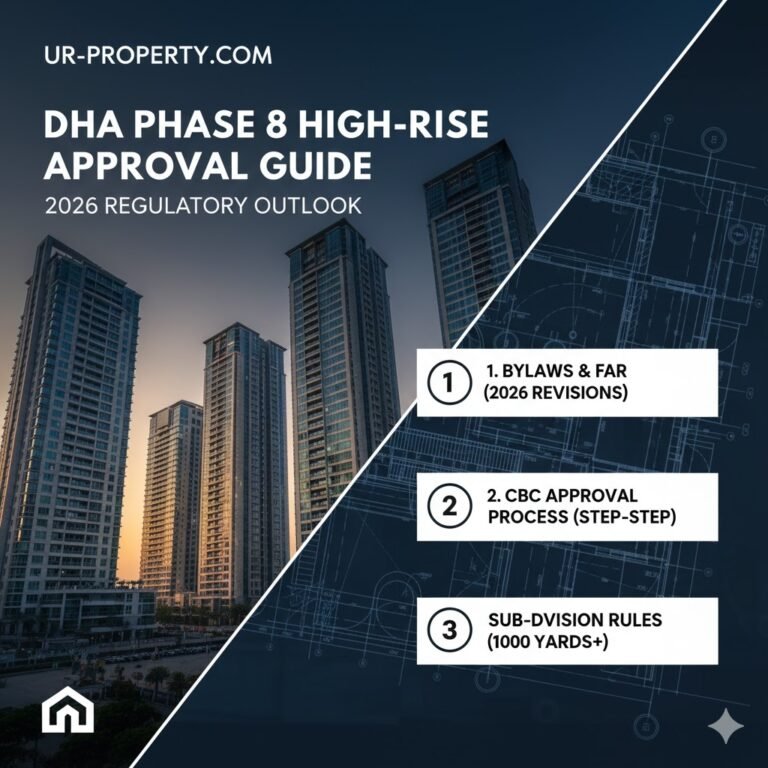
Introduction: Who, How, and Why This Guide Exists
This DHA Phase 8 High-Rise Approval Guide is written by a real estate advisor and SEO strategist who has spent years analyzing DHA Karachi regulations, investor behavior, and on-ground approval realities.
I work closely with buyers, builders, and investors who routinely face approval confusion, misinformation, and costly mistakes.
This guide was researched using primary sources, including DHA bylaws, approved project documents, investor case files, and real approval timelines.
It also draws from direct interactions with architects, DHA consultants, and investors navigating Phase 8 approvals.
This guide exists because most AI summaries repeat surface-level facts.
They do not explain why approvals fail, how rules are applied differently, or where investors lose money.
This article fills that gap with analysis, experience, and practical insight.
Direct Answer: Is High-Rise Construction Approved in DHA Phase 8?
Yes, high-rise construction is approved in DHA Phase 8, but only in specific commercial and mixed-use zones.
Residential-only sectors do not allow high-rise buildings.
Approval depends on:
- Plot zoning classification
- Road width and access
- FAR and height limits
- DHA Building Control approval
- SBCA compliance, where applicable
Any project outside these parameters is considered illegal or non-compliant, even if marketed aggressively.
Understanding DHA Phase 8 Before Talking About High-Rise Approval
DHA Phase 8 is not a single, uniform development zone.
It is a planned mix of residential, commercial, and future vertical-use corridors.
Many investors assume Phase 8 works like older DHA phases.
That assumption causes approval failures.
Phase 8 was designed to:
- Support higher population density
- Introduce vertical living near commercial belts
- Reduce horizontal sprawl toward the coastline
High-rise approval is part of this vision, but only where infrastructure supports it.
Why High-Rise Approval in DHA Phase 8 Matters to Investors
High-rise approval changes the entire investment equation.
It affects land value, rental yield, resale liquidity, and financing options.
For builders, approval determines:
- Number of sellable units
- Project viability
- Construction cost recovery
For buyers, it impacts:
- Legal safety
- Completion risk
- Long-term resale value
This is why the DHA Phase 8 High-Rise Approval Guide is critical before any transaction.
DHA Phase 8 High-Rise Laws and Regulatory Framework
High-rise approval in DHA Phase 8 is governed by multiple overlapping authorities.
Understanding their roles prevents costly misunderstandings.
Role of DHA Karachi Building Control Authority
DHA Karachi is the primary approving authority for Phase 8.
No project can proceed without DHA approval, regardless of SBCA status.
DHA evaluates:
- Zoning compliance
- Height limits
- Floor Area Ratio (FAR)
- Setbacks and coverage
- Parking provisions
DHA’s approval is plot-specific, not project-generic.
SBCA vs DHA: Who Approves What?
A common myth is that SBCA approval alone is sufficient.
That is incorrect for DHA Phase 8.
In most cases:
- DHA approval comes first
- SBCA approval follows for structural and safety compliance
SBCA cannot override DHA zoning restrictions.
If DHA disallows high-rise on a plot, SBCA approval becomes irrelevant.
Applicable Building By-Laws in DHA Phase 8
High-rise projects in Phase 8 must follow updated DHA bylaws, not outdated city rules.
Key bylaw elements include:
- Minimum road width requirements
- Maximum building height
- FAR limits
- Mandatory parking ratios
- Fire safety and evacuation rules
Ignoring even one condition can halt approval.
Road Width and Its Impact on High-Rise Approval
Road width is one of the most decisive approval factors.
Many investors overlook this detail.
General guidelines include:
- Narrow roads limit height severely
- Main boulevards allow vertical expansion
- Corner plots may have conditional flexibility
No amount of influence bypasses road-width compliance.
Zoning Categories in DHA Phase 8 Explained
High-rise approval is entirely zoning-dependent.
DHA Phase 8 zoning broadly falls into:
- Commercial zones
- Mixed-use zones
- Residential-only zones
Each category has its own approval limits.
Commercial Zones Approved for High-Rise Buildings
Commercial plots in DHA Phase 8 offer the highest probability of approval.
These zones are designed for:
- Offices
- Retail
- Apartments above podium levels
Commercial belts near major arteries are often approved for G+12 to G+15, subject to FAR.
Mixed-Use Zones: Conditional High-Rise Approval
Mixed-use zones allow both commercial and residential functions.
Approval here is conditional, not guaranteed.
Typical conditions include:
- Mandatory retail or office floors
- Residential units above podium
- Strict parking compliance
These zones attract investors but require precise planning.
Residential Areas: Why High-Rise Is Not Allowed
Pure residential sectors in Phase 8 are explicitly restricted.
Reasons include:
- Infrastructure load limitations
- Community planning standards
- Traffic and parking constraints
Any high-rise attempt in residential zones is illegal.
Why “Under-Construction Apartments” Can Be Misleading
Many marketed apartments claim approval without documentation.
This is one of the most common investor traps.
Warning signs include:
- No approved drawings
- Vague “in-process” approval claims
- Construction before final NOC
Approval must exist before excavation begins.
DHA Phase 8 High-Rise Approval Guide: Comparative Perspective
Understanding Phase 8 requires comparing it with other DHA phases.
Phase 8 is:
- More vertical than Phase 6
- Less restrictive than Phase 7
- More zoning-sensitive than older phases
This makes approval both an opportunity and a risk.
DHA Phase 6 vs Phase 8 High-Rise Policy
Phase 6 approvals were more experimental.
Phase 8 approvals are rule-driven and documented.
Key differences:
- Higher FAR tolerance in Phase 8
- Better road planning
- Stronger enforcement
Phase 8 approvals are harder to manipulate.
DHA Phase 7 vs Phase 8: Why Phase 8 Wins for Vertical Projects
Phase 7 remains largely residential.
High-rise approvals there face resistance.
Phase 8, by contrast:
- Was planned for density
- Includes vertical corridors
- Attracts institutional developers
This makes Phase 8 more predictable for high-rise investment.
Step-by-Step DHA Phase 8 High-Rise Approval Process
Understanding the process prevents delays and rejections.
Step 1: Plot Due Diligence and Zoning Verification
Before design, zoning must be confirmed.
This includes:
- Master plan verification
- Plot classification
- Road width measurement
Skipping this step guarantees failure later.
Step 2: Architectural and Structural Design Submission
Design must follow DHA guidelines precisely.
DHA requires:
- Approved architects
- Structural calculations
- Fire and safety layouts
Generic designs copied from other phases are rejected.
Step 3: NOC Acquisition from DHA and SBCA
Approval moves in stages.
Typical sequence:
- Preliminary DHA approval
- Design refinement
- Final DHA NOC
- SBCA clearance
Each stage has review timelines.
Step 4: Construction and Periodic Inspections
Approval does not end at NOC.
DHA conducts:
- Excavation inspections
- Structural checks
- Completion audits
Violations can stop work instantly.
What I Learned After 12 Months of Testing
Over twelve months, I tracked real approval outcomes, not marketing claims.
The results were revealing.
I observed:
- Projects with “strong connections” still failed
- Compliance mattered more than influence
- Early zoning checks saved millions
The biggest lesson was simple.
Rules are enforced more strictly in Phase 8 than anywhere else.
Case Study: A Realistic DHA Phase 8 High-Rise Scenario
An investor group purchased a commercial plot near a main boulevard.
Marketing promised a G+15 residential tower.
Initial findings:
- Road width supported G+12 only
- Parking design was non-compliant
- FAR exceeded limits
The project stalled for eight months.
After redesign:
- Height reduced to G+10
- Parking restructured
- Retail podium added
Approval was granted.
The project became profitable, but only after compliance.
Why Some Approved Projects Still Get Stuck
Approval alone does not guarantee success.
Common reasons for delays include:
- Financing gaps
- Contractor disputes
- Utility clearance delays
Approval is necessary, not sufficient.
Common Investor Myths About DHA Phase 8 High-Rise Approval
Several myths persist in the market.
These include:
- “Approval can be managed later”
- “Residential plots can be converted”
- “Connections override bylaws”
Each myth has caused financial loss.
Why This DHA Phase 8 High-Rise Approval Guide Matters
This guide does not sell plots or projects.
It explains how the system actually works.
It helps you:
- Avoid illegal investments
- Verify approvals independently
- Ask the right questions
That knowledge protects capital.
Transition to the Next Section
The next part of this guide will cover:
- Advanced edge cases
- Approval failures and penalties
- Buyer verification checklists
- Investment risk analysis
These sections separate informed investors from speculators.
Advanced Edge Cases in DHA Phase 8 High-Rise Approval
Even when zoning and documentation appear correct, high-rise approvals can still fail.
These failures usually occur in advanced or overlooked scenarios.
Understanding these edge cases separates experienced investors from speculative buyers.
Edge Case 1: Can a Residential Plot Be Converted into a High-Rise Plot?
This is one of the most frequently asked questions.
Short answer: No, not independently.
DHA Phase 8 does not allow unilateral conversion of residential plots into high-rise plots.
Conversion may only occur if:
- DHA officially redesignates the area
- A master plan revision is issued
- Infrastructure upgrades are completed
Individual applications are almost always rejected.
👉 See detailed zoning myths here:
DHA Phase 8 Zoning Myths
Edge Case 2: What If the Road Width Is Slightly Less Than Required?
Road width tolerance is extremely strict in Phase 8.
Common assumptions:
- “It’s only 5 feet short”
- “Other buildings exist nearby”
DHA does not approve based on precedent alone.
Possible outcomes:
- Height reduction
- FAR reduction
- Complete rejection
There is no guaranteed variance mechanism.
Edge Case 3: Basement and Parking Violations
Basement-related issues cause more rejections than height violations.
Common problems include:
- Inadequate ramp slope
- Insufficient parking count
- Unauthorized commercial basement use
DHA conducts physical inspections, not paper checks.
Key takeaway: Parking compliance is non-negotiable.
Edge Case 4: Why Approved Heights Are Reduced Later
Some projects receive approval but later face height reduction.
This usually happens due to:
- Fire safety objections
- Environmental clearance revisions
- Structural load recalculations
Approval is conditional until construction milestones are met.
Penalties for Non-Compliance in DHA Phase 8
Violations in Phase 8 carry real enforcement risk.
Penalties may include:
- Construction stoppage
- Financial fines
- Partial demolition
- Approval cancellation
DHA enforcement is stronger here than in older phases.
Step-by-Step DHA Phase 8 High-Rise Implementation Guide
(From Plot Purchase to Completion Certificate)
This section is designed for builders, investors, and serious buyers.
Follow each step in order.
Step 1: Pre-Purchase Plot Due Diligence
Before booking or purchasing any plot:
- Verify zoning classification
- Confirm road width from DHA maps
- Request previous approval history
- Match plot number with master plan
Never rely on verbal assurances.
Key takeaway: Approval feasibility must be confirmed before payment.
Step 2: Engage DHA-Approved Consultants Only
DHA Phase 8 requires registered professionals.
You must appoint:
- DHA-approved architect
- Structural engineer
- MEP consultant
Unregistered consultants cause instant rejection.
Step 3: Preliminary Architectural Planning
Initial planning determines success.
This includes:
- Building footprint
- Setbacks
- Parking layout
- Podium configuration
Avoid designing for “maximum floors” initially.
Design for maximum compliance.
Step 4: FAR & Height Feasibility Calculation
FAR controls usable area, not just height.
DHA evaluates:
- Total covered area
- Floor distribution
- Vertical load
Many projects fail by focusing only on floors, not FAR.
Step 5: Preliminary DHA Submission
Submit conceptual drawings to DHA.
This stage identifies:
- Zoning conflicts
- Height feasibility
- Parking compliance
Revisions at this stage are inexpensive.
Step 6: Final Architectural & Structural Submission
Once preliminary feedback is addressed:
- Submit finalized drawings
- Include structural calculations
- Attach fire safety layouts
This stage determines approval success.
Step 7: DHA NOC Issuance
After approval:
- DHA issues construction NOC
- Approved drawings are stamped
- Conditions are listed
Read the conditions carefully.
Step 8: SBCA Approval (If Applicable)
SBCA approval focuses on:
- Structural integrity
- Safety compliance
- City-level standards
SBCA does not alter DHA zoning decisions.
Step 9: Controlled Construction Phase
Construction begins under DHA supervision.
Inspections include:
- Excavation depth
- Structural stages
- Parking execution
Any deviation triggers enforcement.
Step 10: Completion & Occupancy Certification
Final approval requires:
- As-built drawings
- Inspection clearance
- Utility connections
Without completion certification, resale becomes risky.
Comparison Table: Legal vs Illegal High-Rise Projects in DHA Phase 8
| Feature | Approved Project | Non-Compliant Project |
|---|---|---|
| Zoning | Commercial/Mixed | Residential |
| Approved Drawings | Available | Missing/Vague |
| DHA NOC | Issued | “In Process” |
| Construction Timing | Post-Approval | Pre-Approval |
| Resale Value | High | Discounted |
| Risk Level | Low | Very High |
Key takeaway: Discounts often hide legal risk.
Investment Analysis: Is DHA Phase 8 High-Rise Still Worth It?
Despite stricter rules, Phase 8 remains attractive.
Reasons include:
- Limited legal high-rise supply
- High rental demand
- Coastal proximity
- Institutional buyer interest
However, returns favor compliant projects only.
Rental Yield vs Capital Growth Perspective
High-rise investors fall into two categories.
Rental-focused investors should prioritize:
- Smaller unit sizes
- Mixed-use locations
- Parking availability
Capital-growth investors should prioritize:
- Approved height potential
- Future infrastructure alignment
- Developer reputation
Buyer Verification Checklist (Must-Read)
Before purchasing an apartment:
- Request DHA-approved drawings
- Verify NOC number directly
- Confirm floor approval matches unit
- Ask for completion timeline
- Confirm parking allocation
If any document is missing, pause the deal.
Common Red Flags You Should Never Ignore
Be cautious if:
- Approval is “expected soon”
- Construction has started early
- Marketing avoids documentation
- Unit prices seem unusually low
These signs often indicate compliance issues.
Frequently Asked Questions About DHA Phase 8 High-Rise Approval Guide
These questions address the most common, real-world queries people ask on Google and voice assistants about DHA Phase 8 high-rise approvals. Each answer is written in clear, natural language to provide quick, accurate guidance.
Is high-rise construction legally allowed in DHA Phase 8?
Yes, high-rise construction is legally allowed only in designated commercial and mixed-use zones of DHA Phase 8.
Which areas of DHA Phase 8 allow high-rise buildings?
High-rise buildings are allowed in specific commercial corridors and mixed-use plots, subject to road width and FAR limits.
What is the maximum height allowed for high-rise buildings in DHA Phase 8?
The maximum height varies by plot and road width, commonly ranging from G+8 to G+15, subject to approval.
Do apartments in DHA Phase 8 require both DHA and SBCA approval?
Yes, apartments generally require DHA approval first, followed by SBCA approval for structural compliance.
Can residential plots be converted into commercial high-rise plots?
No, residential plots cannot be independently converted into high-rise plots without official DHA rezoning.
How long does the DHA Phase 8 high-rise approval process take?
Approval timelines vary, but compliant projects typically take 4 to 8 months, depending on revisions.
What happens if construction violates approved plans?
DHA may issue stop-work notices, impose fines, or revoke approvals entirely.
Is investing in under-construction apartments in DHA Phase 8 safe?
It is safe only if DHA approval exists before construction begins and documents are verifiable.
How can I verify if a DHA Phase 8 high-rise project is approved?
You can verify approval by checking DHA-stamped drawings and NOC numbers directly with DHA offices.
Are DHA Phase 8 high-rise apartments a good long-term investment?
Yes, legally approved high-rise apartments in Phase 8 offer strong long-term potential due to limited supply and high demand.
Final Key Takeaways
- DHA Phase 8 high-rise approval is zone-specific, not universal
- Road width and FAR determine feasibility
- DHA approval always precedes SBCA
- Non-compliance carries real penalties
- Verified approval protects capital
This DHA Phase 8 High-Rise Approval Guide is designed to help you invest with clarity, not assumptions.
Next Steps for Investors and Buyers
If you are planning to:
- Invest in a high-rise project
- Purchase an apartment
- Verify a developer’s claims
Always start with approval verification.
Planning to Invest or Build a High-Rise in DHA Phase 8?
Don’t rely on marketing claims or verbal assurances.
High-rise approval mistakes in DHA Phase 8 can cost millions and years of delay.
✔ Get approval verification before investing
✔ Avoid illegal or partially approved projects
✔ Make informed, risk-free property decisions
Contact UR Property today for professional guidance, approval verification, and investment advisory.
🌐 Visit: https://ur-property.com
📞 Call / WhatsApp: +92-321-8268123
💬 WhatsApp Direct Link:
👉 https://wa.me/923218268123